Most AI security products sell the same fantasy: point a model at your repo, get a pile of findings, pretend the noise is intelligence.
Codex Security looks more credible than that. Not because OpenAI says “agent” a few more times, but because the product is built around a workflow that security teams actually care about: repo-specific context, a threat model you can edit, validation evidence, and patch suggestions that still require human review.
That is the right direction. It is also not magic.
The verdict after reading the launch post, the docs, the setup flow, and the FAQ is blunt: Codex Security could be genuinely useful for teams drowning in triage, but only if those teams already know how to review findings, maintain security context, and reject bad patches. If your AppSec process is weak, this tool will not rescue you. It will just create more expensive confusion.
Executive takeaway
- What looks strong: repo-aware analysis, editable threat models, validation in isolated containers, and patches that plug into existing GitHub review.
- What looks weak: vendor-reported precision claims are promising but still early, access is gated, and initial scans can take hours or even days on larger repositories.
- Best use case: engineering orgs with active GitHub repos and a real security-review habit that want fewer false positives and faster fix suggestions.
- Bad use case: teams hoping AI will replace SAST, security engineers, or patch review.
Why this launch matters now
Software teams are shipping faster because AI coding tools have sped up output. That is great for throughput and terrible for sloppy review. If code velocity goes up while security triage stays manual, AppSec becomes the bottleneck and everyone starts looking for shortcuts.
That is the opening Codex Security is trying to attack.
OpenAI says the product builds system context, finds likely vulnerabilities, validates them where possible, and proposes fixes. That sounds obvious. It isn’t. Most security automation still falls into one of two bad buckets:
- deterministic scanners with broad coverage but lots of low-signal output, or
- LLM wrappers that produce confident prose without enough proof.
Codex Security is interesting because it tries to sit in the middle. OpenAI’s own FAQ explicitly says it does not replace SAST and does not replace manual security review. Good. That alone makes the positioning more believable than the usual “AI now does security” nonsense.
What Codex Security actually does
At a high level, the product runs in four stages:
- connect a GitHub repository through Codex Cloud,
- build a repository-level threat model,
- scan commit history and new commits for likely vulnerabilities,
- validate and propose patches before handing the result back to humans.
That workflow matters more than the brand name.
According to the docs, Codex Security scans repositories commit by commit, can backfill history, and uses the repository’s context to rank findings. The setup docs also make clear that initial scans can take a few hours and, on larger repos, potentially multiple days. That is not a product flaw by itself. It is actually what you should expect if the system is trying to validate findings instead of spamming guesses.
Here’s the review frame that makes the product legible:
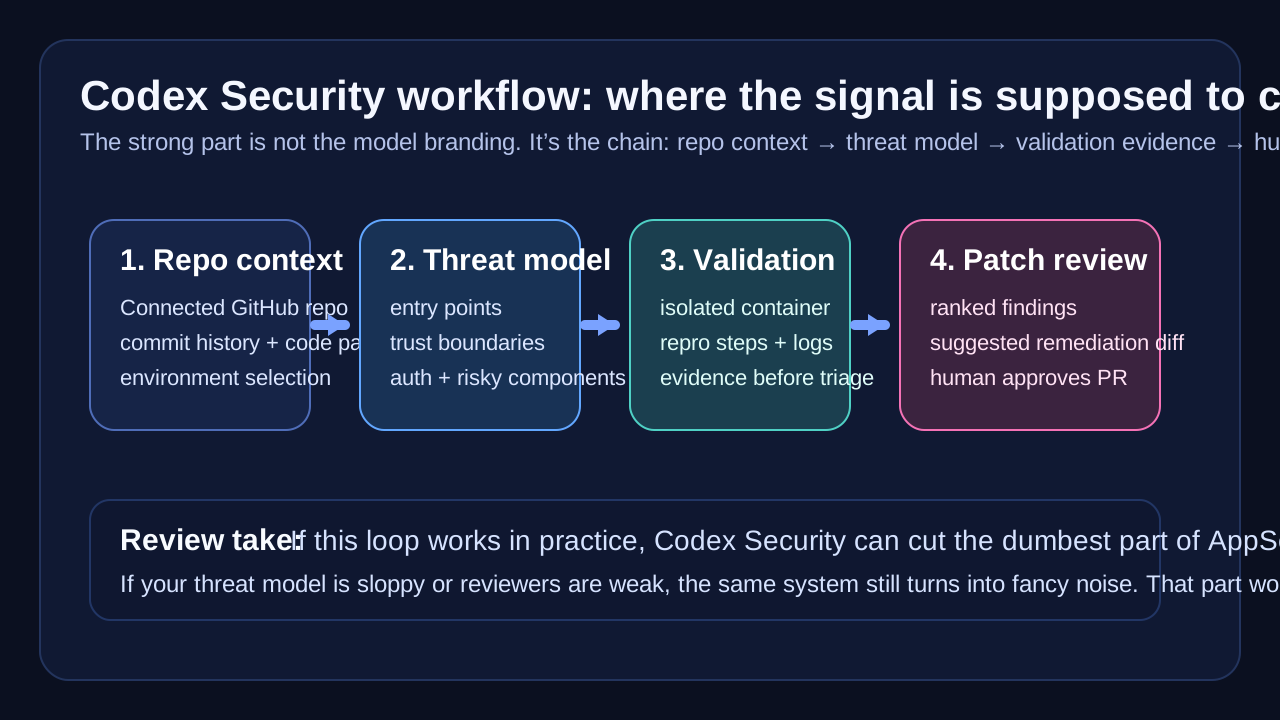
The strongest design choice is the threat model. Codex Security creates an initial version from the code, but the docs repeatedly say you should edit it. That is a tell. OpenAI knows that generic model intuition is not enough. If you want useful prioritization, the system needs your team’s trust boundaries, entry points, risky components, and business context.
That is also the first place where weak teams will screw this up.
The best part is the validation loop, not the model hype
OpenAI’s announcement pushes several numbers: over 1.2 million commits scanned across external repositories in beta, 792 critical findings, 10,561 high-severity findings, one case where noise dropped 84%, more than 90% reduction in over-reported severity, and more than 50% reduction in false positives across repositories.
Those numbers are vendor-reported, so treat them like vendor numbers. Interesting, not gospel.
Still, the product architecture gives those claims at least some plausible backbone. In the FAQ, OpenAI says Codex Security runs analysis and validation in ephemeral isolated containers. If a likely issue can be reproduced, the system can attach logs, commands, exit codes, output, and related artifacts as evidence.
That is the whole ballgame.
Security teams do not just need “possible issue detected.” They need something closer to: here is why it matters, here is the likely root cause, here is the context, here is the evidence, and here is a patch you can inspect. If Codex Security consistently produces that package, it will be more useful than a lot of traditional scanner output and more honest than most AI wrappers.
It also explains why OpenAI keeps talking about “high-confidence findings.” Confidence in security is not just prediction quality. It is whether the finding arrives with enough proof that a human reviewer can act without wasting half a day.
Where The evidence suggests Codex Security will actually work
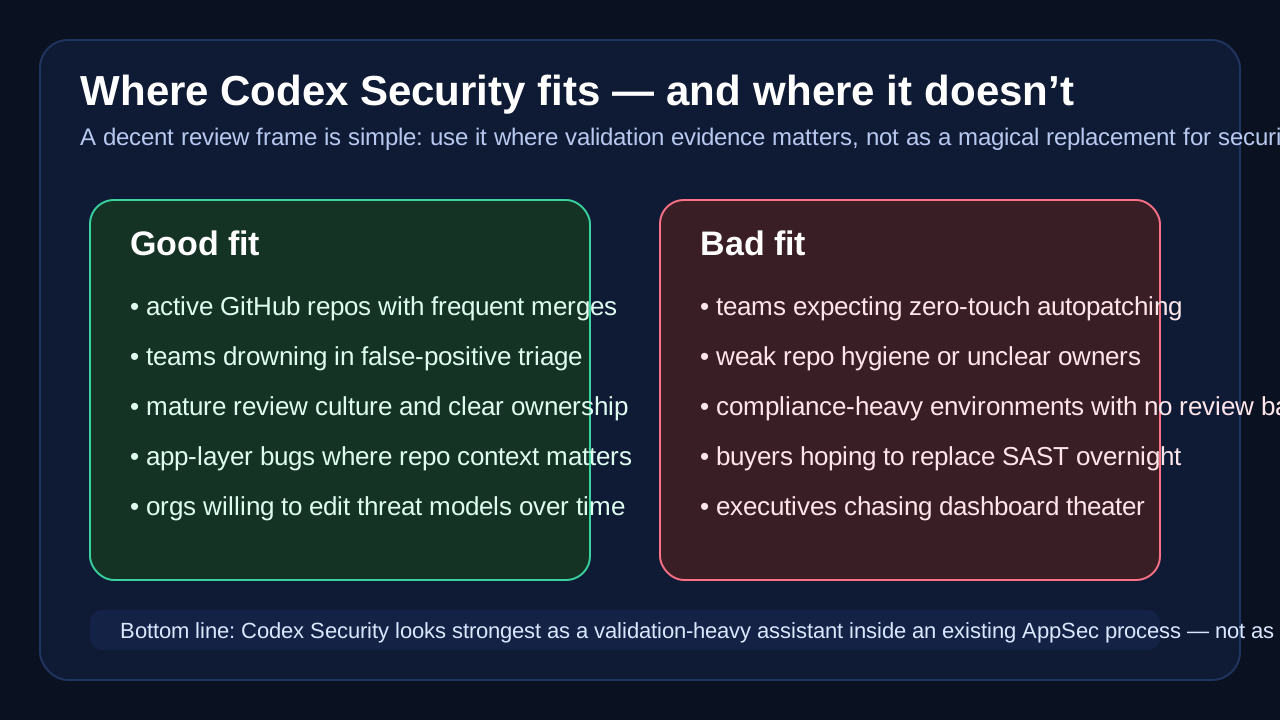
The docs describe a product that is strongest in a very specific environment:
- active GitHub repos,
- a team that can connect them through Codex Cloud,
- reviewers who understand exploitability,
- and enough operational maturity to keep the threat model current.
That means Codex Security is probably a good fit for product engineering orgs that already run modern code review and want to improve signal-to-noise in AppSec.
It also looks especially relevant for application-layer bugs where repository context matters more than generic signatures. OpenAI’s product framing around repo-specific threat models, call-path context, validation steps, and remediation suggestions is built for those messier, semantic problems.
That is why I would take this more seriously than a generic “AI SAST replacement” pitch. It is not trying to win on universal coverage. It is trying to win on better prioritization and faster remediation inside a real workflow.
Where the product still looks fragile
This is the part buyers should not ignore.
1) It still depends on human security judgment
OpenAI says Codex Security does not replace manual review. Believe them. If your team cannot judge exploitability, review a remediation diff, or decide whether a finding matters in business context, the product does not solve that. It just hands you a nicer-looking problem.
2) The threat model can become stale fast
The docs say that if results feel off, the first thing to edit is the threat model. That means product quality depends on a living piece of context that humans maintain. In fast-moving systems, that context can drift. If the threat model is stale, prioritization gets weird and the whole value proposition starts to wobble.
3) Initial scans are not instant
Setup docs explicitly warn that first scans can take hours and sometimes much longer on large repositories. Again, that is probably the cost of doing something useful. But it also means this is not a dopamine product. Teams expecting instant dashboard fireworks are going to get annoyed.
4) Patch suggestions are useful only if review culture exists
Codex Security does not auto-apply patches. Good. It proposes diffs or PR-ready changes for maintainers to inspect. That is the safe posture.
But it also means organizations without disciplined review will either ignore the patches or, worse, trust them too much. Neither outcome is great.
5) “Language-agnostic” is true in theory and messy in reality
The FAQ says Codex Security is language-agnostic, but performance depends on model reasoning for the given language and framework. Exactly. That is a fancy way of saying results will vary. Teams with mixed stacks should assume uneven quality until proven otherwise.
What I would test before buying the story
If I were piloting Codex Security, I would not throw it at the whole engineering org. I would run a narrow trial with one or two repositories where three conditions already exist:
- somebody owns security review,
- the repo has recent merge activity,
- the team can compare findings against an existing baseline.
Then I would measure five things:
- validated findings per week,
- reviewer time saved per finding,
- false-positive rate versus existing scanners,
- patch acceptance rate,
- and whether threat-model edits materially improve prioritization.
That last metric matters a lot. If the product gets noticeably better after a team edits the threat model, that is actually a positive sign. It means the workflow is tunable. If it barely changes, then the “context-aware” pitch may be thinner than advertised.
My product verdict
Codex Security looks like one of the better AI security product designs seen lately because it respects the boring realities of AppSec.
It does not pretend a model can replace security engineering. It does not auto-merge patches. It does not frame itself as the end of SAST. And it places real weight on validation evidence and human review.
That is the good news.
The bad news is just as important: the product still assumes your team has operational discipline. You need clean repository ownership, enough security maturity to maintain the threat model, and reviewers who can inspect patches instead of rubber-stamping them. Without those ingredients, Codex Security will not become a force multiplier. It will become another shiny interface sitting on top of unresolved process debt.
So here is the simple recommendation:
- Pilot it if your team already runs serious GitHub-based engineering workflows and your current AppSec pain is low-confidence noise.
- Wait if your organization still lacks security ownership, repo hygiene, or patch-review discipline.
- Ignore the hype that suggests AI alone will replace real security review. That idea is still bullshit.
Final recommendation
Codex Security is worth watching because it attacks the right problem: not “finding everything,” but reducing the gap between a suspected vulnerability and a reviewable fix.
If OpenAI’s validation-first loop holds up outside launch-week storytelling, this could become a genuinely useful AppSec assistant for mature teams. If not, it will join the pile of AI security tools that generate more words than value.
Right now, the most honest verdict is this: promising product design, credible workflow, still unproven enough that you should pilot carefully instead of buying the dream whole.
Related reads
- GPT-5.4 Is OpenAI’s First Real “Work Model”: What Changed and What to Watch
- OpenAI Codex GPT-5.3 Review: I Gave It a Complex Frontend Task and It Finished in 40 Minutes
- Claude Code vs Codex CLI: Which AI Coding Assistant Wins in 2026?
- Vercel Agent Browser Review: Why Ref-Based Automation Beats DOM Parsing