Quick Answer: Claude Code fits quality-first coding workflows — lower error rates, better at complex multi-file refactors. Codex CLI fits speed-first execution — faster iteration, tighter GitHub integration. Many teams should test a hybrid setup: Claude Code for critical PRs, Codex CLI for routine tasks.
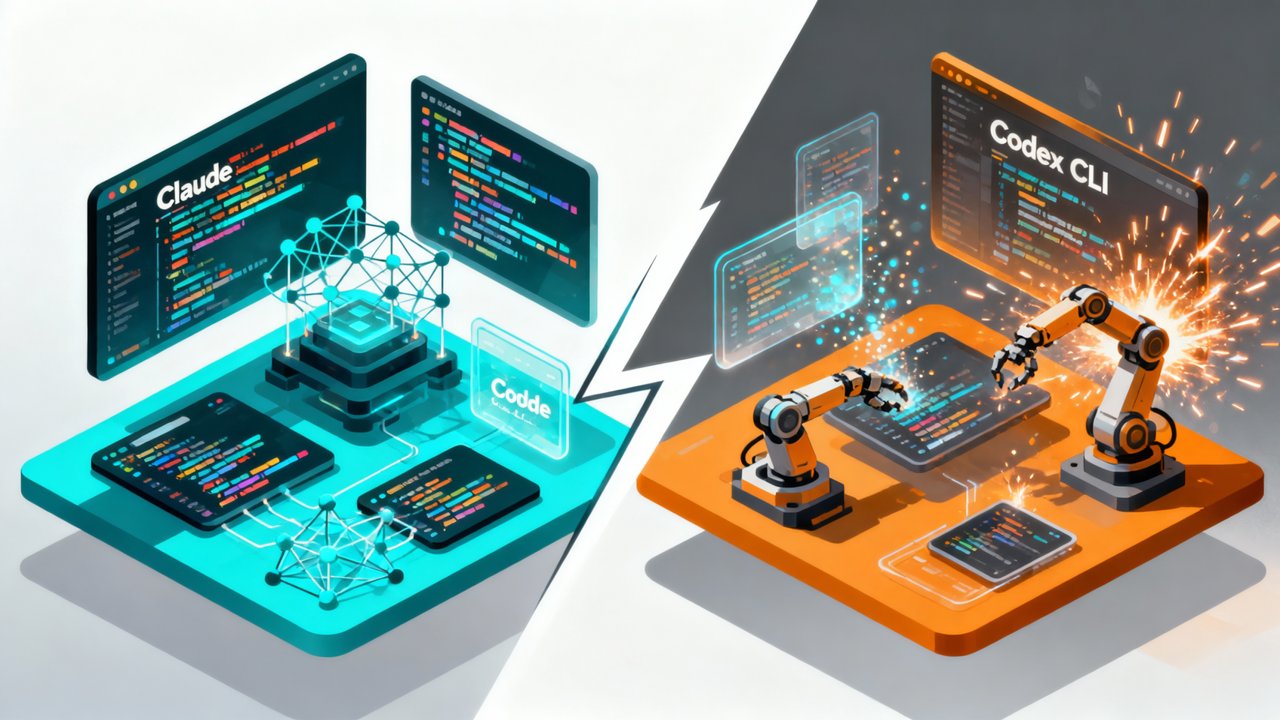
Most teams are asking the wrong question.
It’s not “which model is #1 this week.” It’s “which workflow gives me lower total cost per accepted PR without blowing up code quality.” In that lens, Claude Code and Codex CLI are optimized for different jobs.
Executive takeaway
- Lean toward Claude Code when first-pass correctness matters most (architecture changes, high-coupling refactors, risky production edits).
- Lean toward Codex CLI when iteration speed and background automation matter most (ticket throughput, repetitive code tasks, CI-friendly loops).
- A hybrid setup is often worth piloting: Claude for design/review, Codex for execution/automation.
Why this matters now
Both tools matured fast in 2026, and teams moved from “AI autocomplete” to “agentic coding pipelines.” That shift changes evaluation criteria:
- You now pay for failures, retries, and human review—not just token usage.
- Context handling and tool orchestration affect delivery speed more than single benchmark deltas.
- Security and auditability become hard blockers once AI touches production code.
If you still choose tools by demo quality alone, you’ll overpay and underdeliver.
Decision framework: quality-first vs speed-first
Claude Code (quality-first)
Claude Code usually performs better when tasks require understanding broader architecture before writing code:
- cross-module refactors
- domain-heavy business logic
- “change one thing, break nothing” edits
The practical upside is fewer catastrophic first-pass mistakes and less rework in review.
Codex CLI (speed-first)
Codex CLI is stronger when you need rapid output and repetitive flow automation:
- bulk test scaffolding
- migration boilerplate
- scripted maintenance and issue queues
The practical upside is higher task throughput and lower waiting time between iterations.
Benchmark data: useful but easy to misuse
Yes, both ecosystems publish strong benchmark narratives. No, that still doesn’t settle your buying decision.
Benchmarks evaluate constrained task sets. Your production workload includes hidden complexity:
- legacy code conventions
- undocumented business rules
- flaky dependencies
- team-specific review standards
A 1-2% benchmark delta can disappear instantly if one tool causes 20% more review churn in your repo.
Cost model that actually predicts spend
Use this formula, not token price alone:
Total accepted-output cost = inference + retries + human review + incident risk + delay cost
Typical pattern teams report
- Claude: higher per-call cost, lower rework on complex edits.
- Codex: lower per-call cost, higher iteration count but faster cycles.
If your bottleneck is reviewer capacity, lower rework often beats lower token price. If your bottleneck is ticket volume, faster loops win.
30-day pilot plan (copy this)
Week 1: baseline
- Pick 20 representative tasks from your real backlog.
- Tag each task as complex/refactor or throughput/automation.
- Record current cycle time, review rounds, and rollback rate.
Week 2: split evaluation
- Route complex/refactor tasks to Claude Code.
- Route throughput/automation tasks to Codex CLI.
- Keep prompts and acceptance criteria consistent.
Week 3: failure-mode testing
Test both tools on intentionally difficult scenarios:
- partial requirements
- stale context
- broken tests
- API contract mismatch
Track not just “did it produce code,” but “how expensive was the correction path.”
Week 4: rollout rule
Adopt a routing policy:
- default route by task type
- fallback route if first attempt fails acceptance gate
- mandatory human review for security-sensitive code
Risks and trade-offs you must surface to leadership
- Benchmark tunnel vision
- Mitigation: commit to repo-native eval set, not public leaderboard alone.
- Cost illusion from token-only accounting
- Mitigation: track accepted-output cost weekly.
- Security and compliance drift
- Mitigation: separate data classes, block secrets in prompt context, enforce audit logs.
- Single-vendor dependency risk
- Mitigation: maintain dual-tool prompts and a tested fallback route.
Implementation checklist (production-safe)
- Define “accepted output” rubric before pilot starts.
- Add CI checks that both tools must satisfy (tests, lint, policy rules).
- Require structured PR notes: assumptions, touched files, known risks.
- Keep an incident taxonomy: model error vs prompt error vs tool error vs data error.
- Review route allocation every two weeks.
Who should choose what
Choose Claude Code if:
- you own a large, tightly coupled monorepo
- first-pass correctness matters more than raw speed
- senior reviewers are your scarcest resource
Choose Codex CLI if:
- you need high-volume coding throughput
- you rely on automated/background coding loops
- you are budget-sensitive and can tolerate iterative refinement
Choose hybrid if:
- your backlog mixes architecture-heavy and repetitive implementation work
- you can operationalize routing instead of forcing one-model-for-all
FAQ
Can we run both without doubling complexity?
Yes—if you route by task type and keep one shared acceptance rubric. The complexity comes from poor process, not from two tools.
What’s the lowest-risk way to migrate from one-tool-only?
Start with 20-30% routed traffic plus strict fallback. Don’t do full cutover in week one.
Does one clearly win for Chinese/bi-lingual engineering docs?
In practice both are usable. Evaluate against your team’s actual documentation and ticket style instead of internet anecdotes.
What should we report to management monthly?
Four numbers: accepted-output cost, median cycle time, rollback rate, and reviewer hours per merged PR.
Final recommendation
Pick workflow fit over model fandom. If your biggest pain is bad first drafts, Claude Code will often pay back. If your biggest pain is slow throughput, Codex CLI will often pay back. If your team can operationalize routing, a dual-tool setup is reasonable to test rather than assume.