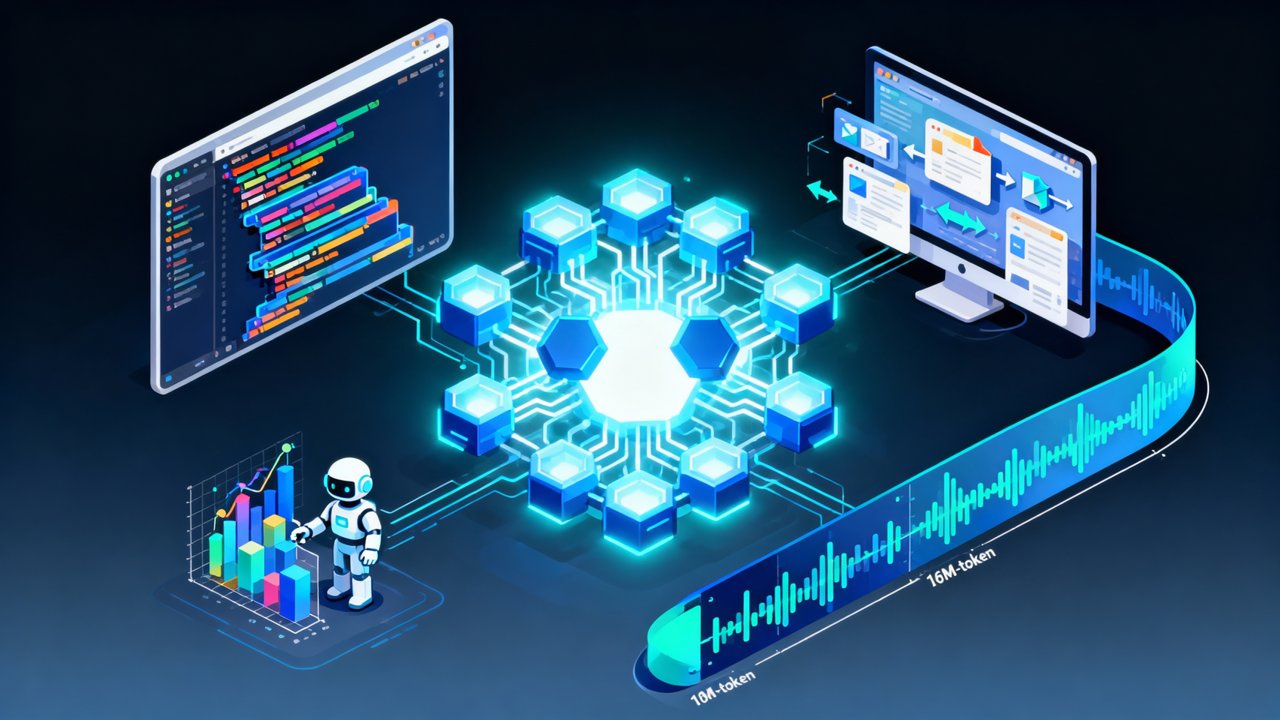
OpenAI’s GPT-5.4 launch is not just another benchmark post. It’s a packaging shift: one model family that tries to do serious knowledge work, coding, and computer-use automation without constantly handing off between specialized models.
Executive takeaway
GPT-5.4 matters because it reduces orchestration overhead. If your team runs real agent workflows, fewer model switches and better tool behavior can create bigger wins than raw benchmark deltas.
What changed
1) Reasoning + coding + computer use in one lane
OpenAI positions GPT-5.4 as a single “professional work” model with 1M-token context, stronger coding, and native computer-use flows. That is strategically important for teams running mixed workloads (analysis + docs + spreadsheets + browser actions).
2) Tool-heavy workflows got first-class attention
Tool search and improved multi-tool behavior target a known bottleneck: large tool catalogs bloat prompts and latency. Better tool routing can cut cost and improve completion reliability.
3) Practical benchmark focus
OpenAI highlighted work-oriented evals (GDPval, SWE-Bench Pro, OSWorld-Verified, Toolathlon, BrowseComp). Whether you trust every number or not, the metric selection itself signals go-to-market direction: from chat quality to task completion.
Who benefits first
- Developer tooling teams building agent pipelines with tool calls and long task chains.
- Operations-heavy teams automating repetitive browser/app workflows.
- Knowledge workers who need fewer back-and-forth turns for structured outputs.
Where teams should stay skeptical
- Benchmarks are not your production stack. Run your own eval harness.
- Computer-use success rates can collapse on messy enterprise UIs.
- Higher capability increases blast radius. Permissioning and approvals are non-negotiable.
30-day rollout plan
Week 1: Baseline
Track task success, latency, token cost, and human intervention for your current model mix.
Week 2: Shadow mode
Run GPT-5.4 in parallel on 2–3 high-volume workflows. Compare output quality and retries.
Week 3: Guardrail hardening
Add mandatory post-action checks, approval gates, and fallback routes.
Week 4: Selective promotion
Promote only workflows that beat baseline on both quality and unit economics.
Final recommendation
Adopt GPT-5.4 where orchestration friction is your bottleneck. Don’t do a blanket migration. Win workload by workload.