
Overview
ByteDance’s Seedance 2.0 launched in China in February 2026 with considerable technical fanfare — a unified multimodal architecture capable of generating cinema-grade video with synchronized audio, multi-shot storytelling, and phoneme-accurate lip sync in over eight languages. Within days, it had gone viral for all the wrong reasons. AI-generated clips of Brad Pitt fighting Tom Cruise, a Darth Vader versus Deadpool lightsaber duel, and a condensed Lord of the Rings spread across social media, racking up millions of views and triggering a coordinated legal response from Hollywood’s most powerful studios. By mid-March 2026, ByteDance had suspended the global rollout entirely, with no new launch date in sight (The Decoder).
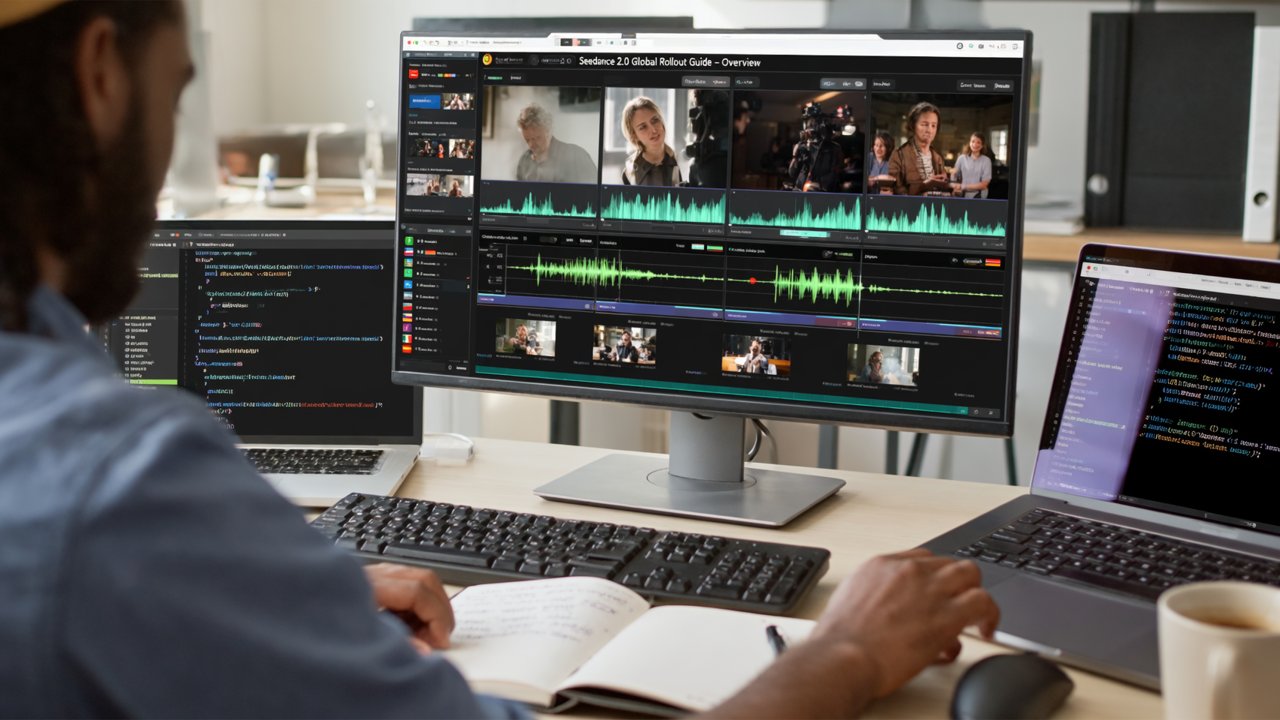
This report examines Seedance 2.0 not as a headline controversy, but as a practical tool — assessing where it fits in real workflows, what implementation looks like, how teams can adopt it, and where the operational risks are concentrated.
Technical Capabilities: What the Tool Actually Does
Before evaluating rollout viability, it is worth establishing what Seedance 2.0 offers technically, because the capability gap between it and competitors is significant and directly shapes adoption decisions.
Seedance 2.0 is built on a unified multimodal audio-video joint generation architecture. Unlike traditional AI video generators that stitch audio in post-processing, Seedance 2.0 synchronizes audio and visual outputs at the model level. This eliminates the persistent desynchronization issues that have plagued earlier tools (NxCode).
Related: Nvidia Bets $26 Billion on Open-Source AI to Fill the Gap OpenAI and Meta Left Behind
Key technical specifications include:
| Feature | Specification |
|---|---|
| Architecture | Unified multimodal audio-video joint generation |
| Max reference files per request | Up to 12 (images, videos, audio) |
| Output resolution | Up to 2K |
| Max clip duration | 15 seconds per shot |
| Multi-shot support | Yes (up to 3 shots per request) |
| Lip sync languages | 8+ |
| Complex scene success rate | 90%+ |
| API pricing | ~$0.10 per minute of generated video |
| API access | Volcengine (China); BytePlus (planned global) |
The 90%+ success rate in rendering complex physical motion is particularly significant for production teams, as it dramatically reduces the retry costs that make other AI video APIs commercially unviable at scale (GlobalGPT).
Related: ByteDance Seedance 2.0 Review: AI Video Generation Gets Real
Workflow Fit: Where Seedance 2.0 Works Well in Practice
Short-Form Commercial Content
The clearest practical use case is short-form commercial video production. A freelancer or small agency producing 10–15 second product ads, social media clips, or explainer videos stands to benefit substantially. The ability to take a product photo and generate a polished clip — with native audio — eliminates multiple post-production steps. At approximately $0.09 per month for consumer tiers (based on reported pricing structures), the cost-per-output ratio is compelling compared to traditional production shoots (Yahoo Finance).
Multi-Shot Storytelling for Content Creators
For content creators building narrative video, the multi-shot capability is a genuine differentiator. Generating three coherent shots in a single API call — with consistent character appearance and synchronized audio — addresses one of the core limitations of earlier tools like Runway and Kling. This makes Seedance 2.0 particularly well-suited for YouTube creators, branded content producers, and social media teams working at volume (NxCode).
Developer Integration for Video-First Applications
The OpenAI-compatible REST API structure means developers already familiar with GPT or Sora integrations can onboard quickly. The API accepts standard JSON payloads and supports multimodal inputs:
import requests

def generate_video(prompt, api_key):
 response = requests.post(
 "https://api.seedance.ai/v1/generations",
 headers={
 "Authorization": f"Bearer {api_key}",
 "Content-Type": "application/json"
 },
 json={
 "model": "seedance-2.0-pro",
 "prompt": prompt,
 "settings": {
 "resolution": "2k",
 "duration": 10,
 "audio": True
 }
 }
 )
 return response.json()
This low integration friction — relative to competitors — makes it attractive for startups building video-first features (NxCode).
Implementation Steps: What Onboarding Actually Looks Like
For teams that do gain access (currently limited to China and select enterprise customers), the implementation path is relatively straightforward:
- API credential acquisition via Volcengine or, for enterprise customers outside China, BytePlus — subject to a reported minimum commitment of 10 million yuan (~$1.45 million USD) just to begin negotiations (The Decoder)
- SDK installation:
pip install seedanceornpm install @seedance/sdk - Initial prompt testing with simple text-to-video requests
- Multimodal input experimentation combining images and audio reference files
- Production pipeline integration with retry logic given the asynchronous generation model
The consumer path — via CapCut’s AI Tools section — is simpler: upload or describe, set parameters, generate. No API keys, no downloads (NxCode).
Team Adoption: Practical Friction Points
Content Filter Instability
The most immediate operational constraint for teams already using Seedance 2.0 in China is the new content filtering layer. Following the Hollywood backlash, ByteDance deployed tighter prompt filters — and paying users report that even harmless prompts are being rejected at a significantly higher rate. This creates unpredictable workflow interruptions that are difficult to plan around in production environments (The Decoder).
For teams building automated video pipelines, this is a serious reliability concern. A filter that rejects legitimate prompts without clear error messaging forces manual review loops that negate the efficiency gains the tool is supposed to deliver.
Enterprise Access Barriers
The 10 million yuan minimum commitment for enterprise access outside China is a structural barrier that effectively excludes all but the largest organizations from the global API. This is not a pricing model — it is a gatekeeping mechanism while ByteDance’s legal team resolves outstanding issues. For mid-market companies and startups, this means Seedance 2.0 is functionally unavailable as an enterprise tool until the global rollout resumes (The Decoder).
Data Sovereignty Concerns
For enterprise teams, particularly those in regulated industries or US-based organizations, ByteDance infrastructure raises data sovereignty questions that are independent of the copyright controversy. Content submitted to the API passes through ByteDance’s cloud infrastructure, which has been a point of regulatory scrutiny in other contexts. Legal and compliance teams will need to assess this before any production deployment (NxCode).
Related: Will AI Replace Marketing Teams? What’s Actually Happening (2026)
Operational Constraints: The Copyright Problem as a Systemic Risk
The Hollywood response to Seedance 2.0 is not a standard IP dispute — it is a coordinated legal campaign from the most powerful content rights holders in the world. Disney, Netflix, Warner Bros., Paramount Skydance, and Sony all issued cease-and-desist letters. The Motion Picture Association called the violations “systemic infringement,” arguing they were a deliberate feature of the model rather than an incidental output (NBC News).
SAG-AFTRA condemned what it called “blatant infringement” including “the unauthorized use of our members’ voices and likenesses,” adding that the tool “disregards law, ethics, industry standards and basic principles of consent” (Variety).
Japan launched its own investigation into potential infringements involving anime characters, adding a second regulatory jurisdiction to the problem (The Decoder).
The MPA’s characterization of the violations as systemic — not incidental — is operationally significant. It suggests that the model’s training data itself is the problem, not just user behavior. This means content filters applied at the output layer may not satisfy the studios’ legal demands, and ByteDance may face pressure to retrain or modify the underlying model. That is a substantially longer remediation timeline than deploying a prompt filter.
Integration Friction: Comparing the Landscape
For teams evaluating Seedance 2.0 against alternatives, the current situation creates a clear decision framework:
| Dimension | Seedance 2.0 | Sora 2 | Veo 3.1 | Kling 3.0 |
|---|---|---|---|---|
| Global availability | Suspended | Available | Available | Available |
| Native audio-video sync | Yes | No | No | No |
| Multi-shot support | Yes | Limited | Limited | Limited |
| API pricing | ~$0.10/min | Higher | Higher | Comparable |
| Copyright risk | High (active disputes) | Lower | Lower | Lower |
| Enterprise access (non-China) | $1.45M minimum | Standard | Standard | Standard |
| Content filter stability | Unstable (post-backlash) | Stable | Stable | Stable |
The technical superiority of Seedance 2.0 is real. Its unified architecture and 90%+ complex scene success rate are genuine advantages. But for teams outside China, those advantages are currently inaccessible, and for teams inside China, the filter instability creates production risk (GlobalGPT).
Rollout Risks: A Structured Assessment
Legal Exposure for Enterprise Customers
Any organization that deploys Seedance 2.0 in a commercial context — even for original content creation — faces indirect legal exposure if the model’s training data is found to infringe on copyrighted works. The MPA’s framing of the issue as systemic means that outputs generated by the model could be challenged regardless of the prompt used. Legal teams at enterprise customers should treat this as an unresolved risk until ByteDance provides transparency about its training data sources (TechBuzz).
Workflow Dependency Risk
Teams that build production pipelines around Seedance 2.0 face the risk of sudden access disruption. The global rollout has already been suspended once with no new date. ByteDance’s legal team is actively working through outstanding issues, and further restrictions — or an extended suspension — are plausible outcomes. Building a critical workflow dependency on a tool in this legal position is a material operational risk (Engadget).
Reputational Risk for Brand Content
For marketing teams and agencies producing branded content, the association between Seedance 2.0 and copyright infringement creates reputational risk independent of legal exposure. Clients may object to AI-generated content produced with a tool under active legal challenge from Disney and Netflix, even if the specific content produced is entirely original.
Where the Tool Works Well: A Practical Verdict
Despite the current constraints, Seedance 2.0 has clear practical value in specific contexts:
- China-based teams producing original commercial content, where access is available and the legal risk profile is different
- Developers building video-first applications who can tolerate the current access limitations and want to position for when the global rollout resumes
- Content creators focused on original material who can navigate the filter instability and are not dependent on consistent output volume
- Enterprise customers with the scale to meet the 10 million yuan access threshold and the legal resources to assess the IP risk independently
The tool is not currently suitable for teams that need reliable, high-volume production pipelines; organizations with strict compliance requirements around training data provenance; or any use case that requires consistent global access.
Conclusion
Seedance 2.0 is technically the most capable AI video generation tool currently available, with a unified architecture that solves real problems in audio synchronization and physics rendering. The copyright crisis it triggered is not a minor compliance issue — it is a fundamental challenge to the model’s training data, backed by the full legal weight of Hollywood’s major studios and actors’ unions. ByteDance’s response has been to add filters and promise safeguards, but the MPA’s characterization of the violations as systemic suggests that output-layer filters may not be sufficient.
For practical rollout purposes, the tool is currently viable only for China-based teams producing original content, and even there, filter instability is creating production friction. Global teams should treat Seedance 2.0 as a tool to monitor and prepare for, not one to build production dependencies on today. The technical case for adoption is strong; the operational and legal case for immediate global deployment is not.
Next Step
Use these pages to keep the decision moving:
- More in Coding — Explore more workflow and implementation coverage in this category.
- Open comparisons — Compare tools head to head before you roll one out.
- Open tool guides — Use the canonical decision pages for fit, pricing context, and alternatives in one place.