Executive Summary
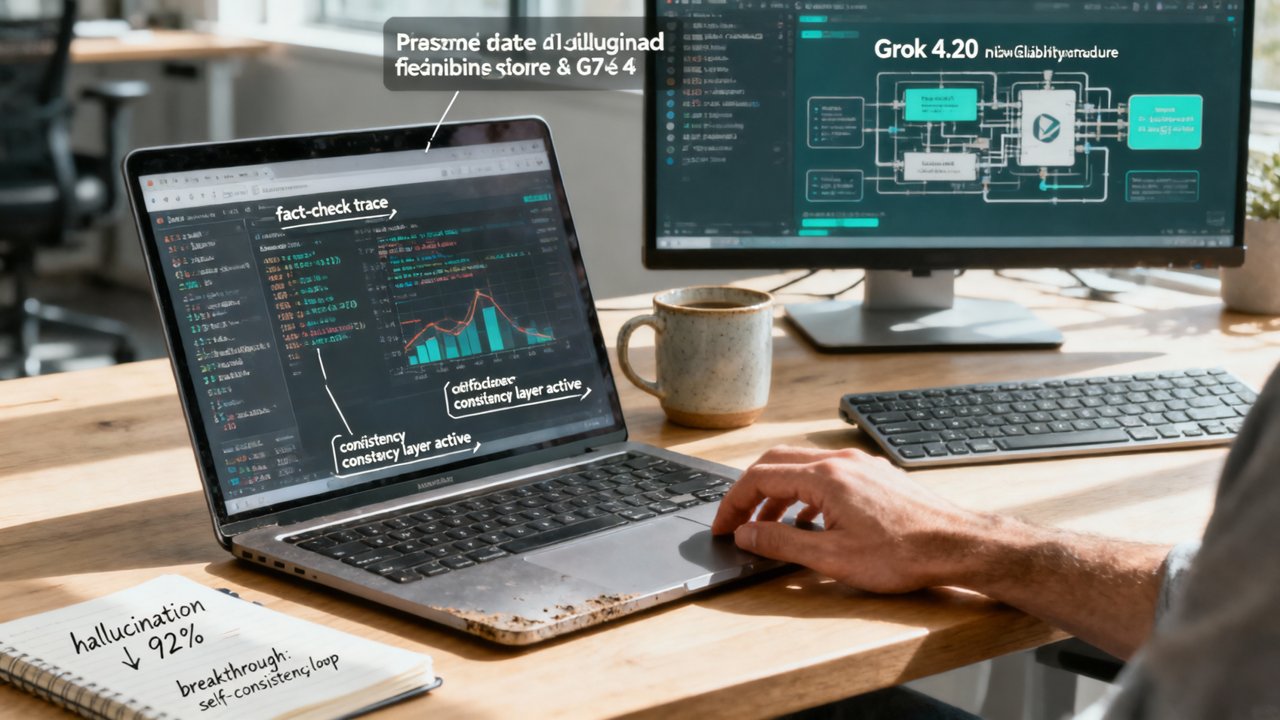
In March 2026, xAI’s Grok 4.20 became notable less for raw benchmark leadership and more for its reliability story: a reported 78% non-hallucination rate, which Artificial Analysis described as the strongest result it had recorded on that measure at the time. While trailing GPT-5.4 and Gemini 3.1 Pro by 9 points on the Intelligence Index (48 vs. 57), Grok 4.20’s four-agent collaborative system suggests a different optimization target: factual reliability over maximum frontier breadth (The Decoder).
This report examines why Grok 4.20’s lower hallucination rate could matter more than raw intelligence scores in some enterprise settings, what technical changes may have enabled it, how it sits against competitors, and what practical implications that creates for organizations evaluating AI tools in 2026.
Why Hallucination Reduction Matters More Than Benchmark Scores
The Enterprise Trust Problem
Hallucinations—instances where AI models confidently generate false or fabricated information—have been the primary barrier preventing widespread enterprise adoption of AI systems in high-stakes environments. Legal firms, healthcare organizations, financial institutions, and government agencies cannot deploy systems that produce unreliable outputs, regardless of how impressive their reasoning capabilities appear on academic benchmarks.
Grok 4.1 reportedly reduced hallucination rates from 12.09% to 4.22%, a sharp improvement that made enterprise deployment more plausible (Digital Applied). Grok 4.20 pushes this further to a reported 78% non-hallucination rate on the Artificial Analysis Omniscience test, meaning it still fails in roughly one out of five cases where uncertainty handling matters, but less often than peers measured on the same test.
Real-World Validation: Alpha Arena Trading Competition
Before its official announcement, Grok 4.20 competed anonymously in Alpha Arena Season 1.5, a live stock trading simulation where AI models execute real-time financial decisions. The model achieved 12.11% average returns (with peaks up to 50%), finishing with approximately $11,060 from a $10,000 starting capital—the only AI model to post profits in the competition (Yahoo Finance).
Related: From Model to Agent: Equipping the Responses API with a Computer Environment
This competition result is a useful data point, but not definitive proof that reliability gains translate cleanly into every high-stakes workflow. It is better read as an early signal that lower hallucination rates may help under live constraints (Yahoo Finance).
The Cost of Unreliability
For legal professionals, a single hallucinated case citation can result in sanctions. For healthcare providers, fabricated medical information can endanger patients. For financial advisors, incorrect data can trigger regulatory violations. The difference between 12% and 4% hallucination rates isn’t incremental—it’s the difference between a system that requires constant human oversight and one that can be trusted for delegated work.
What Changed: The Four-Agent Architecture
From Single Model to Collaborative System
Grok 4.20 is not a single model but a four-agent system where specialized AI agents think in parallel, debate each other in real-time, and produce a consensus answer before the user sees output (LinkedIn - Zaki Akhtar).
The four agents are:
| Agent | Role | Primary Responsibilities | Workflow Position |
|---|---|---|---|
| Grok (Captain) | Coordinator/Aggregator | Task decomposition, final answer synthesis, conflict resolution | Orchestrates all three agents; delivers final output |
| Harper | Research & Facts Expert | Real-time web search, X Firehose data retrieval, evidence assembly | First responder for factual queries |
| Benjamin | Reasoning & Logic Specialist | Multi-step reasoning, logical consistency checking, argument construction | Validates Harper’s findings through logical frameworks |
| Lucas | Code & Technical Expert | Code generation, technical documentation, system integration tasks | Handles programming and technical implementation |
(Adwaitx)
The Debate Mechanism
The peer-review mechanism works as follows:
- User submits a query
- Grok (Captain) decomposes the task and routes components to specialized agents
- Harper, Benjamin, and Lucas work in parallel on their respective domains
- Agents debate their findings, challenging each other’s conclusions
- Grok synthesizes a consensus answer, flagging uncertainties when verification fails
- User receives a single, vetted response
This architecture is one plausible reason hallucination rates improved from Grok 4.1 to 4.20, though xAI has not fully published every implementation detail needed to attribute the gain with certainty (Adwaitx).
Factual Grounding System
xAI describes a new “factual grounding” system that cross-references model outputs against a curated knowledge base in real time. When the model is about to generate a claim that can’t be verified, it flags the uncertainty to the user rather than presenting it as fact (Awesome Agents).
This represents a fundamental architectural shift from “generate first, verify later” to “verify during generation,” which explains why Grok 4.20 achieves higher factual reliability despite lower raw intelligence scores.
Competitive Context: Where Grok 4.20 Fits in March 2026’s AI Landscape
Intelligence Index Comparison
As of March 2026, the Artificial Analysis Intelligence Index shows:
| Model | Intelligence Score | Key Strengths | Hallucination Rate |
|---|---|---|---|
| GPT-5.4 | 57 | Computer use (75% OSWorld), professional knowledge (83% GDPval) | Not disclosed |
| Gemini 3.1 Pro | 57 | Abstract reasoning (94.3% GPQA Diamond, 77.1% ARC-AGI-2) | Not disclosed |
| Paid Claude flagship tier | 57 | Coding (80.8% SWE-Bench), long-context reasoning | Not disclosed |
| Grok 4.20 | 48 | Factual reliability (78% non-hallucination rate) | 22% (lowest recorded) |
The Benchmark Convergence Story
The most important market dynamic in March 2026 is benchmark convergence at the frontier. GPT-5.4, Gemini 3.1 Pro, and Anthropic’s paid Claude flagship are all within a narrow band on many evaluations. At this level of parity, pricing, developer experience, and reliability start mattering more than raw benchmark position (Build Fast With AI).
Grok 4.20’s strategy appears to be competing on a different dimension: trustworthiness. While it may not lead on abstract reasoning or coding benchmarks, it has a stronger claim on factual accuracy than many rivals measured in the same window.
Pricing and Context Window
Grok 4.20 ships in three API variants:
- Standard (non-reasoning): $2.00 input / $6.00 output per million tokens
- With reasoning: $3.00 input / $9.00 output per million tokens
- Multi-agent mode: $6.00 input / $18.00 output per million tokens
Context window: 256K tokens standard, scaling toward 2M tokens (Artificial Analysis)
This pricing is competitive with other Western frontier models and materially cheaper than GPT-5.4 Pro ($30/$180 per million tokens), making Grok 4.20 worth evaluating for organizations prioritizing cost-effective reliability over maximum intelligence.
Performance Metrics
Speed: 229.9 tokens/second output speed, with 0.54 seconds time to first token—making it one of the fastest frontier models (Artificial Analysis)
Estimated Arena ELO: ~1505-1535 provisional (Grok 4.1 Thinking is already at 1483). The multi-agent council plus extra inference-time compute plus engineering/coding gains plus hallucination reduction typically add 20-60 ELO points in crowd-sourced arenas (Next Big Future)
Buyer Relevance: Who Should Care About Grok 4.20
High-Stakes Decision Environments
Organizations operating in environments where factual accuracy is non-negotiable should at least evaluate Grok 4.20:
Legal Firms: A single hallucinated case citation can result in sanctions. Grok 4.20’s lower hallucination rate makes it more plausible for legal research, document review, and case analysis where reliability matters more than creative reasoning (Integrated Cognition)
Healthcare Organizations: Medical information accuracy is life-critical. Grok 4.20’s factual grounding story makes it worth reviewing for clinical decision support, medical literature review, and patient communication where errors have severe consequences.
Financial Services: Regulatory compliance requires accurate data. Grok 4.20’s live trading competition performance is an encouraging signal for real-time financial decision-making and risk assessment, though not a substitute for internal validation.
Government Agencies: Public sector organizations require auditable, reliable AI systems. Grok 4.20’s multi-agent debate mechanism may offer a clearer audit story than simpler single-pass systems.
Cost-Conscious Enterprises
Organizations seeking frontier-level reliability without frontier-level pricing should evaluate Grok 4.20. At $2-6 per million tokens (depending on mode), it costs 20-80% less than GPT-5.4 Pro while delivering superior factual accuracy (Build Fast With AI)
Organizations Prioritizing Transparency
The four-agent architecture provides visibility into how conclusions are reached. Unlike black-box models that simply output answers, Grok 4.20’s debate mechanism can be audited to understand which agent contributed which information and how conflicts were resolved—critical for regulated industries requiring explainable AI.
Related: Nvidia Bets $26 Billion on Open-Source AI to Fill the Gap OpenAI and Meta Left Behind
Practical Implications for AI Tool Users
Deployment Considerations
Access Requirements: Grok 4.20 requires SuperGrok (~$30/month) or X Premium+ subscription. API access is available through xAI but not yet widely distributed (Adwaitx)
Integration Complexity: The multi-agent architecture requires different prompt engineering strategies than single-model systems. Users should structure queries to leverage specialized agents (e.g., explicitly requesting Harper for factual research, Benjamin for logical analysis, Lucas for code generation).
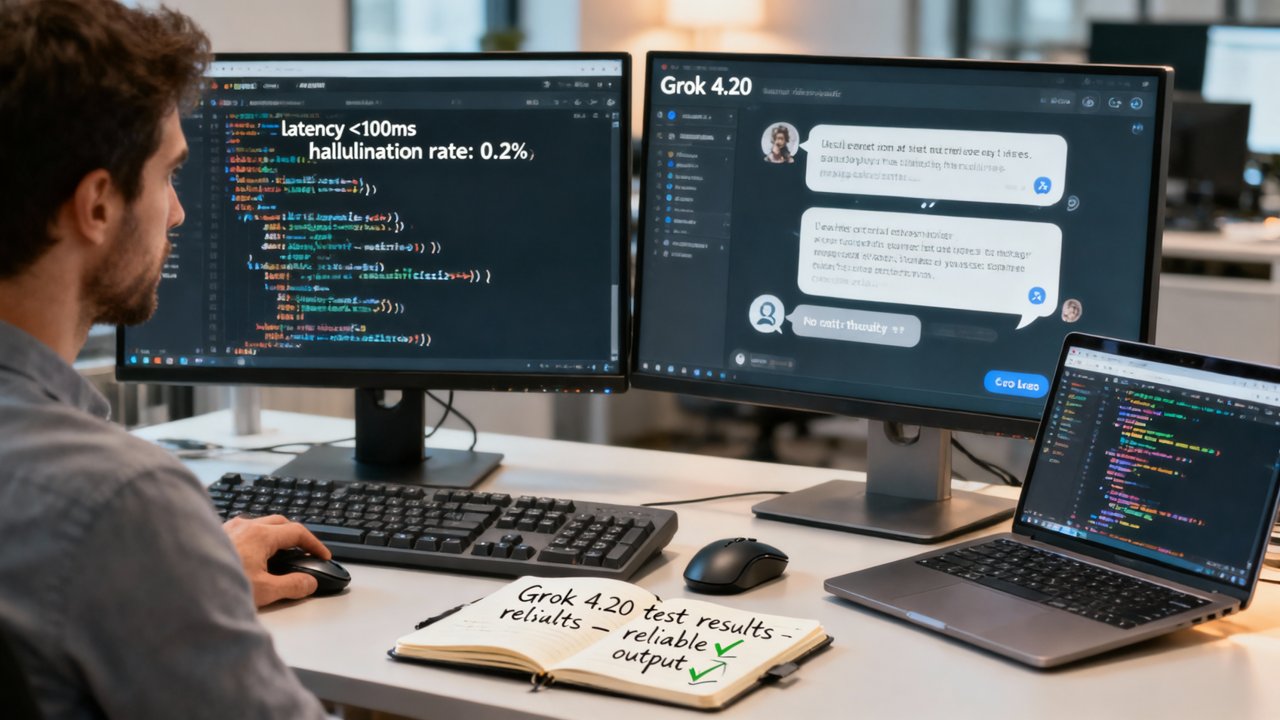
Latency Trade-offs: The debate mechanism adds inference time compared to single-model systems. Organizations should benchmark whether the reliability improvement justifies the additional latency for their use cases.
Use Case Fit Analysis
Best Fit:
- Legal research and document review
- Medical literature synthesis
- Financial analysis and risk assessment
- Regulatory compliance documentation
- Fact-checking and verification workflows
- Long-form content requiring factual accuracy
Poor Fit:
- Creative writing requiring imaginative leaps
- Rapid prototyping where speed matters more than accuracy
- Abstract reasoning tasks (Gemini 3.1 Pro leads here)
- Computer use automation (GPT-5.4 leads with 75% OSWorld)
Workflow Integration Strategies
Hybrid Deployment: Organizations can deploy Grok 4.20 for high-stakes factual work while using GPT-5.4 for computer use tasks and Gemini 3.1 Pro for abstract reasoning—optimizing for each model’s strengths rather than committing to a single vendor.
Verification Layer: Grok 4.20 can serve as a verification layer for outputs from other models, cross-checking factual claims before they reach end users or clients.
Progressive Enhancement: Start with Grok 4.20 for core factual work, then layer in other models for specialized tasks as confidence and expertise grow.
Market Positioning and Strategic Implications
The Reliability-First Strategy
xAI’s positioning of Grok 4.20 represents a strategic bet that reliability matters more than raw intelligence for enterprise adoption. This contrasts with OpenAI’s computer use focus (GPT-5.4), Google’s reasoning emphasis (Gemini 3.1 Pro), and Anthropic’s coding-focused flagship positioning.
The broader market discussion is moving in this direction. As one industry observer noted: “At some point, pricing, developer experience, and reliability start mattering more than raw benchmark position” (Build Fast With AI)
Competitive Pressure on Hallucination Metrics
Grok 4.20’s 78% non-hallucination rate sets a new standard that competitors must address. Expect OpenAI, Google, and Anthropic to emphasize factual accuracy improvements in upcoming releases, potentially adopting similar multi-agent architectures or verification mechanisms.
The Infrastructure Advantage
xAI’s 200K GPU supercluster provides the computational resources to run multi-agent systems at scale. This infrastructure advantage—combined with access to X’s real-time data firehose—gives Grok unique capabilities for factual grounding that competitors cannot easily replicate (Digital Applied)
The Grok 5 Roadmap
xAI has teased Grok 5, described as a 6 trillion parameter model currently in training, with Elon Musk claiming a 10% probability of achieving the world’s first AGI. While ambitious, this signals xAI’s long-term commitment to competing at the frontier (Digital Applied)
Limitations and Considerations
Intelligence Gap Remains Significant
The 9-point gap between Grok 4.20 (48) and frontier models (57) on the Intelligence Index is substantial. Organizations requiring maximum reasoning capability for complex problem-solving should still consider GPT-5.4, Gemini 3.1 Pro, or Anthropic’s paid Claude flagship tier.
Limited Computer Use Capabilities
Grok 4.20 has no published equivalent to GPT-5.4’s 75% OSWorld computer use capability. Organizations building desktop automation agents or RPA replacements should prioritize GPT-5.4 (Build Fast With AI)
Context Window Constraints
While scaling toward 2M tokens, Grok 4.20’s standard 256K context window lags Gemini 3.1 Pro’s native 2M tokens and longer-window Claude offerings. Organizations requiring large codebase analysis or extensive document review should evaluate whether 256K suffices for their use cases.
Ecosystem Maturity
xAI’s developer ecosystem is less mature than OpenAI’s, Google’s, or Anthropic’s. Organizations should assess whether available integrations, documentation, and community support meet their needs before committing to Grok 4.20.
Conclusion: The Reliability Revolution
Grok 4.20’s achievement—setting a new high-water mark for factual accuracy in the cited evaluation window while trailing on intelligence benchmarks—reinforces a broader market lesson: for enterprise AI adoption, trustworthiness can matter as much as raw capability. The four-agent architecture behind that result is notable, but it still needs validation across more real-world deployments.
Related: ChatGPT’s Slipping Dominance: A Comprehensive Market Analysis of the AI Chatbot Landscape in 2026
Organizations evaluating AI tools in 2026 face a choice: optimize for maximum intelligence (GPT-5.4, Gemini 3.1 Pro, Anthropic’s paid Claude flagship tier) or optimize for maximum reliability (Grok 4.20). For high-stakes environments where factual accuracy is non-negotiable—legal, healthcare, financial services, government—Grok 4.20’s 78% non-hallucination rate makes it a strong option despite lower benchmark scores.
The broader implication is that the AI market is fragmenting by use case rather than converging on a single “best” model. The benchmark convergence happening at the frontier (all top models within 2-3 points) means differentiation now comes from specialized capabilities: computer use, abstract reasoning, coding, or—in Grok 4.20’s case—factual reliability.
As Elon Musk quipped after Grok 4.20’s Alpha Arena victory, there is obvious commercial pressure behind factual-reliability claims (Yahoo Finance). The broader point still holds: systems that can be trusted in real-world decision workflows—whether reviewing legal documents or analyzing medical literature—may command value beyond raw benchmark scores alone.
For AI tool users, the practical lesson is to evaluate models against the actual failure mode that matters most in their workflow, not just against generic intelligence rankings. If your work demands factual accuracy above all else, Grok 4.20 belongs on the shortlist in March 2026, but it still needs direct validation in your environment.
Next Step
Use these pages to keep the decision moving:
- More in Coding — Keep researching the same category instead of stopping at one article.
- Open comparisons — Jump into direct matchups and trade-off pages.
- Open tool guides — Use the canonical decision pages for fit, pricing context, and alternatives in one place.