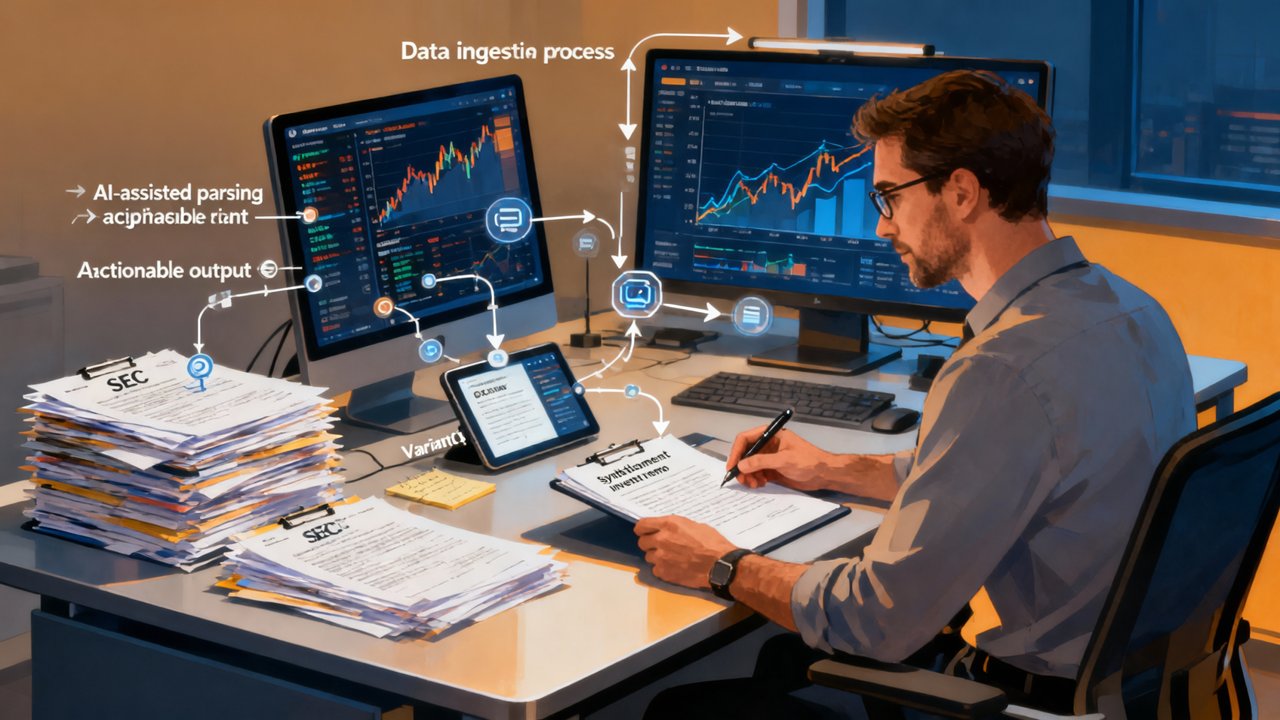
Most enterprise AI case studies read like marketing collateral. This one is more useful than most.
OpenAI’s customer story on Balyasny Asset Management is worth reading for one reason: it describes an operating model, not just a shiny demo. Balyasny says it built a centralized Applied AI team, benchmarked models before deployment, used GPT-5.4 as one reasoning layer inside a wider system, and pushed scoped agents into real analyst workflows with compliance controls attached. That is the part other companies can copy.
If you strip away the hedge-fund mystique, the lesson is blunt: the teams getting real AI gains in 2026 are not buying one magical model. They are building a controlled pipeline around evaluation, permissions, and feedback.
Executive takeaway
Do not copy Balyasny’s domain. Copy its sequence.
- Centralize the hard platform work.
- Benchmark models against your own tasks before rollout.
- Give agents scoped tools instead of unlimited freedom.
- Keep humans in the review loop where mistakes are expensive.
- Improve the system from real usage traces, not launch-day vibes.
That sequence is portable to finance, legal ops, procurement, enterprise support, revenue operations, and any other document-heavy workflow where speed matters but silent errors are unacceptable.
Why this case matters now
The timing is not random. OpenAI launched GPT-5.4 as a model aimed at professional work: stronger spreadsheet handling, better tool search, native computer use, and a long context window for multi-step tasks. Those capabilities only matter if a team can plug them into a real workflow without turning the whole company into a hallucination casino.
That is why the Balyasny example stands out. OpenAI says the firm created an Applied AI team in late 2022 with roughly 20 researchers, engineers, and domain experts. The firm now operates across about 180 investment teams, so the challenge was never just “can a model answer questions?” The challenge was “can we build a system that works across many teams, under compliance pressure, with decisions that actually matter?”
That is a better enterprise AI question than most companies are asking.
The architecture is the story
Balyasny’s reported setup is interesting because it does three things at once:
- centralizes platform-level controls,
- decentralizes workflow usage to domain teams,
- keeps model choice empirical instead of ideological.
That last point matters a lot. According to the OpenAI case study, Balyasny evaluates models across more than 12 dimensions, including forecasting accuracy, numerical reasoning, scenario analysis, and robustness to noisy inputs. GPT-5.4 won enough of those tests to become one reasoning engine in the stack, but not the whole stack.
That is the right mindset. Vendor benchmark charts are useful for marketing decks. They are a terrible basis for production policy.
Here is the portable version of what Balyasny appears to have built:

One-view breakdown of the operating model
| Layer | What Balyasny says it does | Why this matters outside finance |
|---|---|---|
| Evidence intake | Pulls from filings, broker research, earnings materials, expert calls, and internal data | Serious AI systems need structured and unstructured inputs together, not just chat prompts |
| Model evaluation | Tests models across 12+ dimensions on internal benchmarks | You should validate on task-level performance, not trust generic leaderboard wins |
| Scoped agents | Uses GPT-5.4 with tools, planning, retrieval, and guardrails | Tool access and permissions determine whether an agent is useful or reckless |
| Central platform | Applied AI team owns architecture, tooling, and compliance controls | Shared infrastructure prevents every department from inventing its own broken mini-stack |
| Local customization | Investment teams tailor workflows to their asset class | Domain teams should adapt the last mile without rewriting the core platform |
| Feedback loop | Real-time feedback on outputs, tool execution, and outcomes | AI quality improves fastest when trace data feeds back into prompts, tools, and evals |
That is not “use AI more.” That is operational design.
Five moves worth copying immediately
1) Evaluate models like they are vendors, not celebrities
Balyasny’s evaluation discipline is the first thing worth stealing. The firm says it tests models on internal benchmarks before deployment, including noisy-input robustness and scenario analysis. Good. That is how adults do this.
Too many enterprise teams still choose models like consumers choose phones: a mix of benchmarks, vibes, and CEO excitement. That is bullshit. If your workflow touches customer money, legal exposure, or executive decisions, model selection should behave more like procurement than fandom.
A sane evaluation pack should answer:
- Can the model reason correctly over your actual documents?
- Does it stay stable when inputs are incomplete or messy?
- Does tool use improve output, or just add failure points?
- Can reviewers explain where the answer came from?
If you cannot answer those four questions, you are not rolling out AI. You are gambling with prettier slides.
2) Treat GPT-5.4 as a component, not a religion
OpenAI’s GPT-5.4 launch post emphasizes stronger spreadsheet work, better tool search, native computer-use capabilities, lower hallucination rates versus GPT-5.2, and up to 1M tokens of context. Those are real advantages for complex analyst-style workflows.
But the Balyasny story matters precisely because the firm does not appear to bet everything on one monolithic model. GPT-5.4 is used as a reasoning engine within a broader system, while internal models are selected task by task.
That is the smart move for most companies too.
Use frontier models where they clearly outperform: planning, synthesis, tool coordination, document-heavy reasoning. Use narrower or cheaper systems where they are good enough. The goal is not ideological purity. The goal is a workflow that is fast, reliable, and reviewable.
3) Centralize guardrails, then localize the work
This may be the most valuable part of the case study.
Balyasny says its Applied AI team develops the shared agent frameworks, toolchains, and compliance guardrails, while individual investment teams adapt those capabilities to macro, commodities, equities, and other strategies. That creates one shared safety and platform layer with many local use cases on top.
That beats both bad extremes:
- Full centralization: one generic AI tool nobody loves because it fits nobody’s work.
- Full decentralization: every team spins up its own prompts, tools, and shadow workflows until governance becomes a crime scene.
If you run a company with multiple departments, this is probably your target architecture too. Centralize identity, permissions, logging, evaluation, and data boundaries. Let domain teams customize workflows, templates, and success criteria.
Where the reported gains actually matter
Balyasny’s published outcomes are dramatic enough that you should read them with healthy skepticism. OpenAI says:
- deep research tasks that took days now take hours,
- central-bank speech analysis dropped from two days to about 30 minutes,
- merger-arbitrage monitoring shifted from spreadsheets and manual alerts to continuous probabilistic updates,
- roughly 95% of investment teams actively use the platform.
Vendor case studies always look cleaner than reality. Fine. Discount the numbers if you want. The directional signal still matters.
The real gain is not “AI replaced analysts.” It is that AI handled the ugly middle of the workflow: reading too many documents, maintaining context across them, surfacing changes, and pushing structured drafts or updates back to humans faster.
That is exactly where a lot of enterprise teams drown today.
What non-finance teams should steal first
You do not need a hedge fund to benefit from this architecture. You need a workflow with too much information, too much repetition, and too much review drag.
Here is the practical translation by function:
| Team | Best first AI target | Human checkpoint that must stay |
|---|---|---|
| Finance / FP&A | Scenario refreshes, variance analysis prep, earnings packet synthesis | Final numbers and assumptions sign-off |
| Legal ops | Contract comparison, clause extraction, policy drift review | Legal approval on redlines and risk interpretation |
| Procurement | Vendor packet review, pricing change summaries, compliance checks | Vendor selection and contract acceptance |
| Security | Triage of findings, evidence gathering, remediation summaries | Severity decisions and production remediation approval |
| RevOps / support | Account review briefs, ticket trend analysis, renewal risk synthesis | Customer-facing actions and escalation decisions |
The common pattern is simple: let AI compress the evidence-gathering and synthesis phase, then require humans to approve the consequential decision.
The part people will still screw up
The easiest way to misunderstand the Balyasny story is to think the model is the product. It is not. The controls are.
If your AI system cannot do the following, it is not production-grade for high-risk work:
- show what sources it used,
- separate tool permissions by role,
- log actions and outputs for review,
- improve from real reviewer feedback,
- fail safely when confidence is weak or evidence conflicts.
The danger is not that AI will be useless. The danger is that it will be useful enough to earn trust before your organization has earned the right to trust it.
That is how expensive mistakes happen: not from obvious nonsense, but from fluent outputs that slide past weak controls.
Final recommendation
Balyasny’s case matters because it treats AI like infrastructure, not office software.
That is the right instinct. The companies that get durable AI gains in 2026 will not be the ones with the flashiest internal demo. They will be the ones with:
- the best task-level evals,
- the cleanest permission model,
- the tightest human review loop,
- and the discipline to treat model choice as an evidence question.
If you want a copyable rule from this case, use this one: centralize the platform, localize the workflow, and make evaluation non-negotiable.
That is a lot less glamorous than “AI analyst replaces humans.” It is also a lot more likely to work.